

How To Install New Windows
This browser is no longer supported.
Upgrade to Microsoft Edge to take advantage of the latest features, security updates, and technical support.
Install .NET on Windows
- Install on Windows
- Install on macOS
- Install on Linux
In this article, you'll larn how to install .Net on Windows. .Net is made upwards of the runtime and the SDK. The runtime is used to run a .NET app and may or may not be included with the app. The SDK is used to create .Cyberspace apps and libraries. The .Cyberspace runtime is always installed with the SDK.
The latest version of .NET is half dozen.
Supported releases
The following tabular array is a list of currently supported .NET releases and the versions of Windows they're supported on. These versions remain supported until either the version of .NET reaches cease-of-support or the version of Windows reaches finish-of-life.
Windows 10 versions stop-of-service dates are segmented by edition. Only Home, Pro, Pro Educational activity, and Pro for Workstations editions are considered in the post-obit table. Check the Windows lifecycle fact sheet for specific details.
Tip
A + symbol represents the minimum version.
| Operating System | .NET Core 3.ane | .Cyberspace v | .Net 6 |
|---|---|---|---|
| Windows eleven | ✔️ | ✔️ | ✔️ |
| Windows Server 2022 | ✔️ | ✔️ | ✔️ |
| Windows x Version 21H1 | ✔️ | ✔️ | ✔️ |
| Windows ten / Windows Server, Version 20H2 | ✔️ | ✔️ | ✔️ |
| Windows 10 / Windows Server, Version 2004 | ✔️ | ✔️ | ✔️ |
| Windows 10 / Windows Server, Version 1909 | ✔️ | ✔️ | ✔️ |
| Windows ten / Windows Server, Version 1903 | ✔️ | ✔️ | ✔️ |
| Windows 10, Version 1809 | ✔️ | ✔️ | ✔️ |
| Windows 10, Version 1803 | ✔️ | ✔️ | ✔️ |
| Windows 10, Version 1709 | ✔️ | ✔️ | ✔️ |
| Windows 10, Version 1607 | ✔️ | ✔️ | ✔️ |
| Windows viii.1 | ✔️ | ✔️ | ✔️ |
| Windows 7 SP1 ESU | ✔️ | ✔️ | ✔️ |
| Windows Server 2019 Windows Server 2016 Windows Server 2012 R2 Windows Server 2012 | ✔️ | ✔️ | ✔️ |
| Windows Server Core 2012 R2 | ✔️ | ✔️ | ✔️ |
| Windows Server Cadre 2012 | ✔️ | ✔️ | ✔️ |
| Nano Server, Version 1809+ | ✔️ | ✔️ | ✔️ |
| Nano Server, Version 1803 | ✔️ | ❌ | ❌ |
For more information well-nigh .Cyberspace 6 supported operating systems, distributions, and lifecycle policy, see .Cyberspace 6 Supported Bone Versions.
Unsupported releases
The following versions of .NET are ❌ no longer supported. The downloads for these however remain published:
- .Cyberspace Core 3.0
- .Cyberspace Core 2.two
- .Cyberspace Core two.1
- .Net Cadre 2.0
Runtime information
The runtime is used to run apps created with .Cyberspace. When an app author publishes an app, they can include the runtime with their app. If they don't include the runtime, it's up to the user to install the runtime.
There are three different runtimes you can install on Windows:
-
ASP.Net Core runtime
Runs ASP.NET Core apps. Includes the .Cyberspace runtime. -
Desktop runtime
Runs .Cyberspace WPF and Windows Forms desktop apps for Windows. Includes the .NET runtime. -
.NET runtime
This runtime is the simplest runtime and doesn't include whatsoever other runtime. It'due south highly recommended that yous install both ASP.Internet Core runtime and Desktop runtime for the all-time compatibility with .NET apps.
SDK information
The SDK is used to build and publish .Net apps and libraries. Installing the SDK includes all three runtimes: ASP.NET Core, Desktop, and .NET.
Arm-based Windows PCs
The following sections draw things you should consider when installing .Cyberspace on an Arm-based Windows PC.
What's supported
The following table describes which versions of .Cyberspace are supported on an Arm-based Windows PC:
| .NET Version | Architecture | SDK | Runtime | Path conflict |
|---|---|---|---|---|
| 6.0 | Arm64 | Yes | Yep | No |
| 6.0 | x64 | Yes | Yes | No |
| v.0 | Arm64 | Yep | Yep | Yes |
| v.0 | x64 | No | Yes | Aye |
| 3.1 | Arm64 | No | No | N/A |
| iii.1 | x64 | No | Yeah | Yes |
The x64 and Arm64 versions of the .Net 6 SDK exist independently from each other. If a new version is released, each install needs to be upgraded.
Path differences
On an Arm-based Windows PC, all Arm64 versions of .NET are installed to the normal C:\Program Files\dotnet\ folder. All the same, when you install the x64 version of .NET half dozen SDK, it's installed to the C:\Plan Files\dotnet\x64\ folder.
Path conflicts
The x64 .Net 6 SDK installs to its own directory, as described in the previous section. This allows the Arm64 and x64 versions of the .NET 6 SDK to exist on the same machine. However, any x64 SDK prior to 6.0 isn't supported and installs to the same location as the Arm64 version, the C:\Program Files\dotnet\ folder. If you want to install an unsupported x64 SDK, y'all'll need to first uninstall the Arm64 version. The reverse is as well true, you lot'll need to uninstall the unsupported x64 SDK to install the Arm64 version.
Path variables
Environment variables that add .Net to organization path, such as the PATH variable, may demand to be changed if you have both the x64 and Arm64 versions of the .Cyberspace 6 SDK installed. Additionally, some tools rely on the DOTNET_ROOT environment variable, which would also demand to exist updated to point to the advisable .NET half dozen SDK installation folder.
Dependencies
- .Internet 6
- .NET 5
- .Net Cadre 3.one
- .NET Cadre iii.0
- .Cyberspace Core 2.2
- .NET Core 2.one
The following Windows versions are supported with .NET 6:
Note
A + symbol represents the minimum version.
| Bone | Version | Architectures |
|---|---|---|
| Windows eleven | 21H2 | x64, Arm64 |
| Windows ten Client | 1607+ | x64, x86, Arm64 |
| Windows Customer | 7 SP1+, 8.ane | x64, x86 |
| Windows Server | 2012+ | x64, x86 |
| Windows Server Core | 2012+ | x64, x86 |
| Nano Server | 1809+ | x64 |
For more information about .Internet 6 supported operating systems, distributions, and lifecycle policy, see .NET 6 Supported Bone Versions.
Windows 7 / Vista / 8.1 / Server 2008 R2 / Server 2012 R2
More dependencies are required if you're installing the .NET SDK or runtime on the following Windows versions:
| Operating System | Prerequisites |
|---|---|
| Windows seven SP1 ESU | - Microsoft Visual C++ 2015-2019 Redistributable 64-fleck / 32-bit - KB3063858 64-bit / 32-chip - Microsoft Root Certificate Authority 2011 (.NET Core ii.1 offline installer only) |
| Windows Vista SP ii | Microsoft Visual C++ 2015-2019 Redistributable 64-chip / 32-bit |
| Windows viii.1 | Microsoft Visual C++ 2015-2019 Redistributable 64-bit / 32-fleck |
| Windows Server 2008 R2 | Microsoft Visual C++ 2015-2019 Redistributable 64-bit / 32-bit |
| Windows Server 2012 | Microsoft Visual C++ 2015-2019 Redistributable 64-bit / 32-chip |
| Windows Server 2012 R2 | Microsoft Visual C++ 2015-2019 Redistributable 64-bit / 32-bit |
The previous requirements are too required if yous receive an mistake related to either of the following dlls:
- api-ms-win-crt-runtime-l1-one-0.dll
- api-ms-win-cor-timezone-l1-ane-0.dll
- hostfxr.dll
Install with PowerShell automation
The dotnet-install scripts are used for CI automation and non-admin installs of the runtime. Y'all can download the script from the dotnet-install script reference page.
The script defaults to installing the latest long term support (LTS) version, which is .Cyberspace 6. Yous can cull a specific release by specifying the Channel switch. Include the Runtime switch to install a runtime. Otherwise, the script installs the SDK.
dotnet-install.ps1 -Channel six.0 -Runtime aspnetcore Install the SDK past omitting the -Runtime switch. The -Aqueduct switch is set up in this example to Current, which installs the latest supported version.
dotnet-install.ps1 -Channel Electric current Install with Visual Studio
If you lot're using Visual Studio to develop .NET apps, the following table describes the minimum required version of Visual Studio based on the target .NET SDK version.
| .Cyberspace SDK version | Visual Studio version |
|---|---|
| 6.0 | Visual Studio 2022 version 17.0 or higher. |
| v.0 | Visual Studio 2019 version 16.8 or higher. |
| 3.1 | Visual Studio 2019 version sixteen.4 or higher. |
| 3.0 | Visual Studio 2019 version sixteen.3 or college. |
| ii.2 | Visual Studio 2017 version fifteen.9 or higher. |
| 2.one | Visual Studio 2017 version 15.7 or college. |
If y'all already take Visual Studio installed, you lot tin can check your version with the following steps.
- Open up Visual Studio.
- Select Aid > About Microsoft Visual Studio.
- Read the version number from the About dialog.
Visual Studio tin can install the latest .NET SDK and runtime.
Select a workload
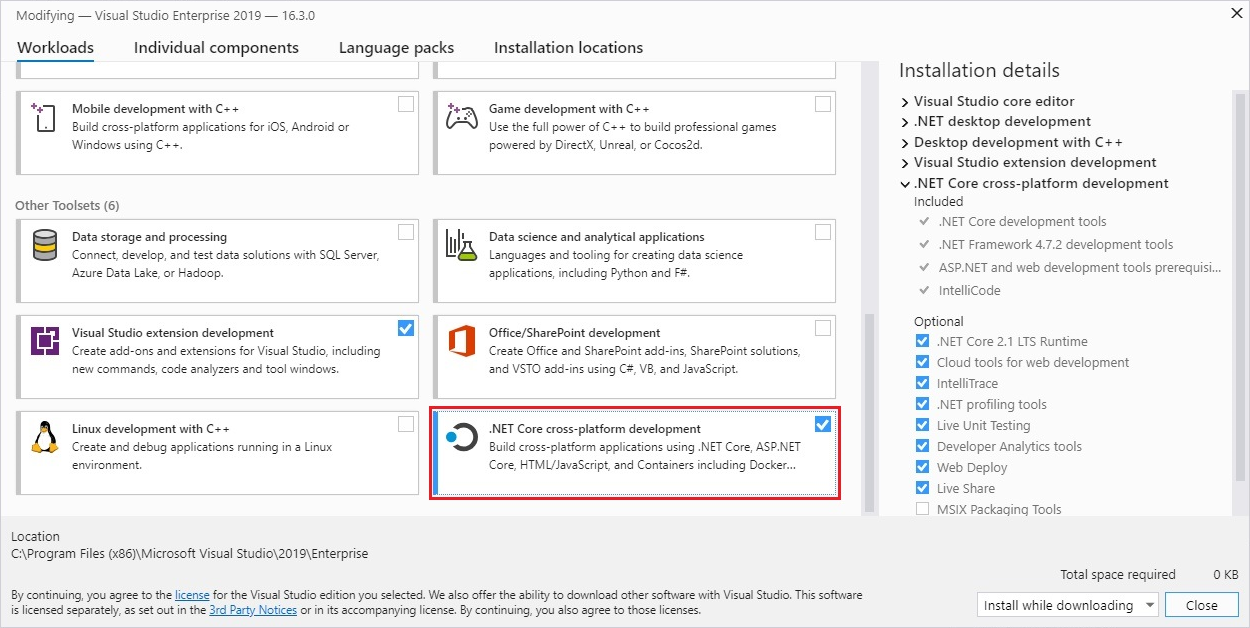
When installing or modifying Visual Studio, select one or more of the post-obit workloads, depending on the kind of application you're edifice:
- The .NET Cadre cross-platform development workload in the Other Toolsets department.
- The ASP.Cyberspace and web development workload in the Web & Cloud department.
- The Azure development workload in the Spider web & Deject section.
- The .Internet desktop development workload in the Desktop & Mobile section.
Install alongside Visual Studio Code
Visual Studio Lawmaking is a powerful and lightweight source lawmaking editor that runs on your desktop. Visual Studio Code is available for Windows, macOS, and Linux.
While Visual Studio Code doesn't come with an automatic .Internet Core installer like Visual Studio does, adding .Internet Cadre support is elementary.
- Download and install Visual Studio Code.
- Download and install the .NET SDK.
- Install the C# extension from the Visual Studio Code marketplace.
Windows Installer
The download page for .Net provides Windows Installer executables.
When you use the Windows installers to install .NET, you can customize the installation path past setting the DOTNETHOME_X64 and DOTNETHOME_X86 parameters:
dotnet-sdk-3.1.301-win-x64.exe DOTNETHOME_X64="F:\dotnet\x64" DOTNETHOME_X86="F:\dotnet\x86" If you want to install .NET silently, such as in a production environment or to support continuous integration, use the following switches:
-
/install
Installs .NET. -
/placidity
Prevents any UI and prompts from displaying. -
/norestart
Suppresses any attempts to restart.
dotnet-sdk-3.1.301-win-x64.exe /install /quiet /norestart For more information, meet Standard Installer Command-Line Options.
Tip
The installer returns an exit code of 0 for success and an exit code of 3010 to indicate that a restart is required. Any other value is generally an error code.
Download and manually install
As an culling to the Windows installers for .NET, yous can download and manually install the SDK or runtime. Transmission install is usually done as part of continuous integration testing. For a developer or user, information technology'south generally better to utilize an installer.
Both .Net SDK and .Cyberspace Runtime can be manually installed after they've been downloaded. If you install .NET SDK, you don't need to install the corresponding runtime. Commencement, download a binary release for either the SDK or the runtime from one of the post-obit sites:
- .NET 6 downloads
- .Cyberspace 5 downloads
- .NET Core 3.ane downloads
- All .NET Core downloads
Create a directory to extract .Internet to, for example %USERPROFILE%\dotnet. Then, extract the downloaded zip file into that directory.
By default, .NET CLI commands and apps won't use .NET installed in this mode and you must explicitly cull to use it. To do and then, change the environment variables with which an application is started:
set DOTNET_ROOT=%USERPROFILE%\dotnet ready PATH=%USERPROFILE%\dotnet;%PATH% set DOTNET_MULTILEVEL_LOOKUP=0 This approach lets yous install multiple versions into separate locations, so explicitly choose which install location an application should use by running the application with environment variables pointing at that location.
When DOTNET_MULTILEVEL_LOOKUP is fix to 0, .NET ignores whatever globally installed .NET version. Remove that surroundings setting to allow .NET consider the default global install location when selecting the best framework for running the application. The default is typically C:\Program Files\dotnet, which is where the installers install .NET.
Docker
Containers provide a lightweight style to isolate your application from the residual of the host arrangement. Containers on the same motorcar share just the kernel and use resources given to your application.
.NET tin run in a Docker container. Official .Net Docker images are published to the Microsoft Container Registry (MCR) and are discoverable at the Microsoft .NET Docker Hub repository. Each repository contains images for different combinations of the .Internet (SDK or Runtime) and Bone that you can apply.
Microsoft provides images that are tailored for specific scenarios. For instance, the ASP.Internet Core repository provides images that are built for running ASP.NET Cadre apps in production.
For more data about using .Net in a Docker container, run across Introduction to .Net and Docker and Samples.
Troubleshooting
After installing the .NET SDK, you may meet bug trying to run .NET CLI commands. This department collects those common issues and provides solutions.
- It was not possible to find any installed .Cyberspace Core SDKs
It was not possible to observe whatsoever installed .Cyberspace Cadre SDKs
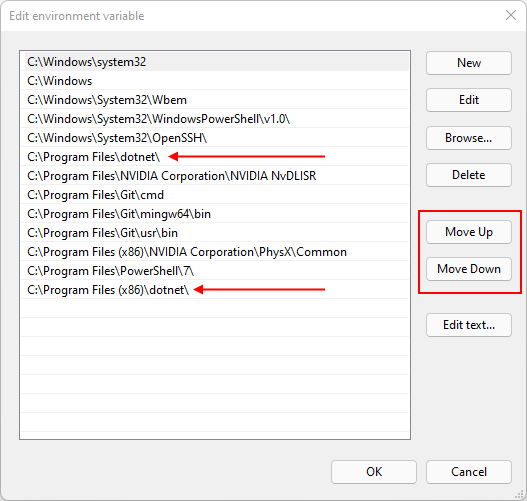
Nigh probable you've installed both the x86 (32-bit) and x64 (64-bit) versions of the .Cyberspace SDK. This is causing a conflict because when you run the dotnet command it'due south resolving to the x86 version when it should resolve to the x64 version. This is usually fixed past adjusting the %PATH% variable to resolve the x64 version first.
-
Verify that you lot have both versions installed by running the
where.exe dotnetcommand. If you do, you lot should meet an entry for both the Programme Files\ and Plan Files (x86)\ folders. If the Program Files (x86)\ folder is outset as indicated by the following case, it's incorrect and you should proceed on to the next step.> where.exe dotnet C:\Program Files (x86)\dotnet\dotnet.exe C:\Program Files\dotnet\dotnet.exeIf information technology'south correct and the Program Files\ is first, you don't have the problem this department is discussing and you should create a .Internet assistance request issue on GitHub
-
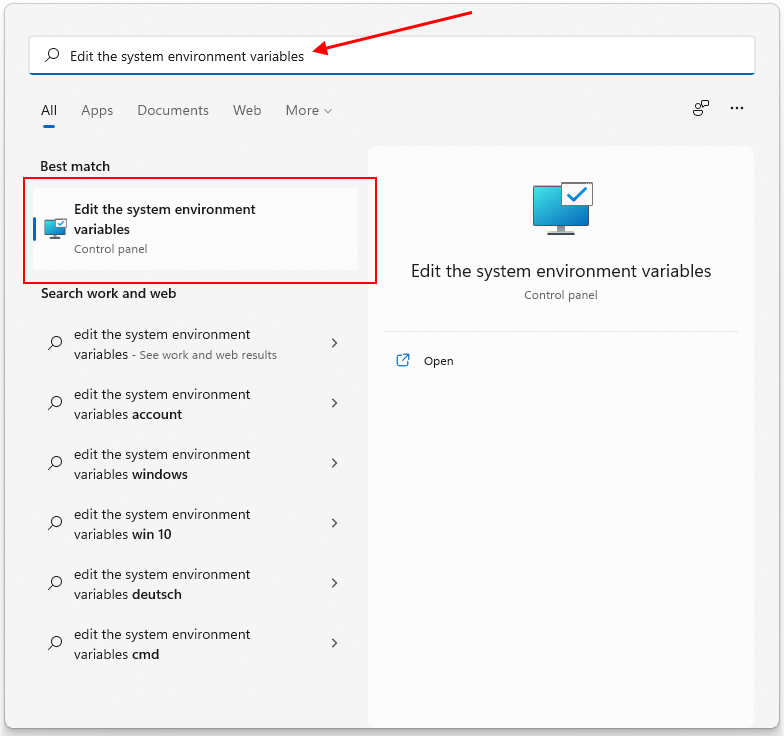
Press the Windows button and type "Edit the organization environment variables" into search. Select Edit the system environment variables.
-
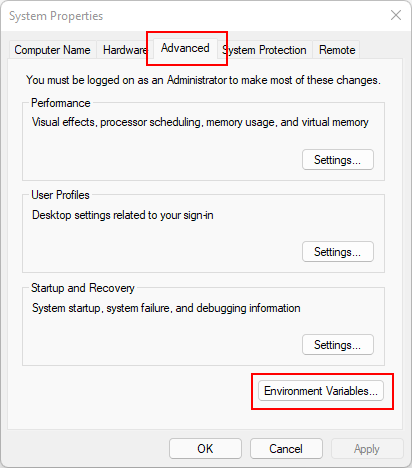
The System Properties window opens upwardly to the Avant-garde Tab. Select Environment Variables.
-
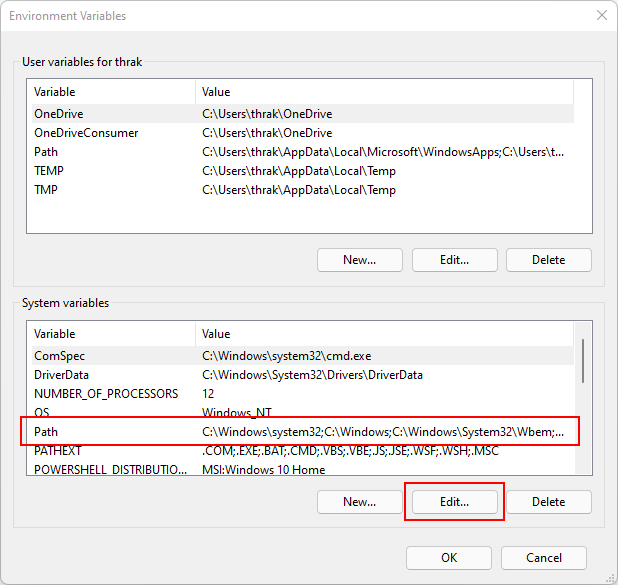
On the Surround Variables window, under the System variables group, select the Path* row and then select the Edit button.
-
Utilise the Move Up and Move Downwards buttons to movement the C:\Program Files\dotnet\ entry to a higher place C:\Plan Files (x86)\dotnet\.
Next steps
- How to check if .Net is already installed.
- Tutorial: Hello World tutorial.
- Tutorial: Create a new app with Visual Studio Code.
- Tutorial: Containerize a .Internet Cadre app.
Feedback
Submit and view feedback for

How To Install New Windows,
Source: https://docs.microsoft.com/en-us/dotnet/core/install/windows
Posted by: fuentespasomenton.blogspot.com
0 Response to "How To Install New Windows"
Post a Comment