

Do People Believe That Flints Water Is Clean
O n a hot twenty-four hour period in the summertime of 2022, in the Civic Park neighbourhood where Pastor R Sherman McCathern preached in Flint, Michigan, water rushed out of a couple of fire hydrants. Puddles formed on the dry grass and splashed the skin of the delighted kids who ran through it. Only the spray looked strange. "The water was coming out nighttime equally coffee for hours," McCathern remembered. The shock of information technology defenseless in his throat. "Something is wrong hither."
Something had been wrong for months. That spring, Flint, nether direction from land officials, turned off the drinking water it had relied upon for nearly 50 years. The city planned to bring together a new regional system, and while it waited for it to be congenital, it began bringing in its water from the Flintstone River. McCathern didn't pay much attending to the politicking around all this; he had plenty to worry most at his busy parish.
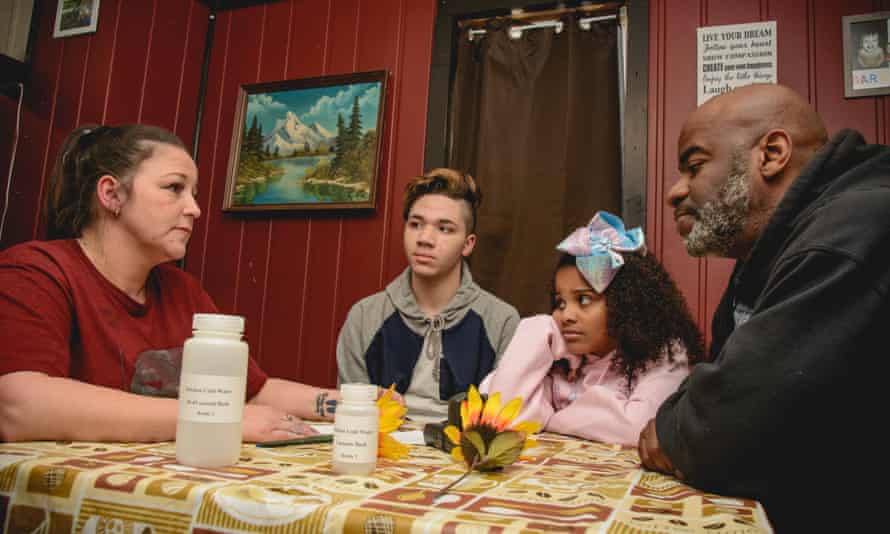
But later on the switch, many of his neighbours grew alarmed at the water that flowed from their kitchen taps and showerheads. They packed public meetings, wrote questioning letters, and protested at metropolis hall. They filled plastic bottles to prove how the water looked dark-brown, or orange, and sometimes had particulates floating in it. Showering seemed to be connected with skin rashes and hair loss. The water smelled foul. A sip of it put the taste of a common cold metallic money on your tongue.
But the regime "said everything was all right and you could potable information technology, so people did," McCathern said later on. Residents were advised to go out the taps on for a few minutes before using the water, to get a clean catamenia. As the months went by, the urban center plant tinkered with treatment and issued a few boil-water advisories. Land environmental officials said again and again that there was cipher to worry about. The water was fine.
Whatsoever their senses told them, whatsoever the whispers around town, whatsoever Flint'due south troubled history with powerful institutions telling them what was all-time for them, this wasn't really hard for people like McCathern to believe. Public water systems are one of America's most heroic accomplishments, a feat so successful that it is almost invisible. By making it a commonplace for clean water to exist delivered to homes, businesses and schools, untold lives accept been saved from cholera, dysentery and typhoid fever. In Flint, the water supply was instrumental in turning General Motors – founded in 1908 in Vehicle Urban center, as Flint was known – into a global economic giant. The advancing underground network of pipes divers the growing metropolis and its metropolitan region, which boasted of being domicile to 1 of the strongest centre classes in the country.
But in the latter function of the 20th century, GM closed nigh of its plants in the city and eliminated about all of the local auto jobs. Smaller companies followed suit or simply shut down for good. Betwixt 1998 and 2022 lonely, virtually 150 of them left the downtown area. With the shuttered businesses came shuttered houses and schools. More half the population, which had reached a loftier point of nigh 200,000 in 1960, disappeared. Some 22,000 people left between 2000 and 2022.
The empty structures they left backside were both disheartening and dangerous, non simply because they were prone to break-ins and fires, but also because they literally crumbled on to the sidewalks where people passed by. Civic Park's tree-lined avenues of historic homes became blighted by vacancy. At the same fourth dimension, the Flint metro region – that is, the suburbs – grew exponentially. It was a widening circumvolve of wealth with a deteriorating centre.
With so much lost, Flint needed help. An emergency plan. A big-scale intervention of some kind. But in fact the state of Michigan exacerbated Flintstone's woes by dramatically reducing the money that it funnelled to its cities. Between 1998 and 2022, Michigan diverted more than $five.5bn in tax revenues – which would ordinarily go to places such as Flint, to power streetlights, mow parks and plow snow – and used it to plug holes in its own budget. At the same time, Flintstone suffered the Slap-up Recession, the mortgage crisis and a major restructuring of the auto industry.
If you lot wanted to kill a city, that is the recipe. And notwithstanding Flint was very much live. In 2022, the year of the switch to a new source of drinking h2o, it was the 7th-largest city in the land. For about 99,000 people, Flint was abode. And they did what they could to fill the gaps. When Pastor McCathern and his congregation at Joy Tabernacle realised that Borough Park was non on anyone's listing of priorities, they launched their own initiatives to ready upwards the neighbourhood. They covered the windows and doors of vacant properties, and paid young men to mow lawns and lath up empty homes.
"The community was at one time totally ignored past everybody," McCathern said. "But considering young people stood up, at present everybody came on board." You lot could feel a shift in the momentum. You could meet the change. "It was a different Flintstone that was coming."
But on that sweltering summertime day, in that location was that water pouring out of the fire hydrant, as children sprinted back and forth through its spray. Nighttime as java.
This is the story of how the city of Flint was poisoned past its own h2o. It was not because of a natural disaster, or unproblematic negligence, or even considering some corner-cutting company was blinded by profit. Instead, a disastrous selection to interruption a crucial environmental law, followed by eighteen months of filibuster and cover-up by the metropolis, state and federal governments, put a staggering number of citizens in peril.
I n a city with plenty of urgent matters competing for attention – poverty, vacancy, schools, crime, jobs – one matter Flintstone didn't have to worry about before the spring of 2022 was the quality of its water. The Detroit water and sewerage department (DWSD) had supplied Flintstone with good water for nearly 50 years. The large public utility drew from the freshwater of Lake Huron, a lake so deep and fierce that it once swallowed eight ships in a single tempest. Flint's ain treatment plant, which information technology had used to treat its river water before joining the DWSD in the 1960s, sabbatum idle. It remained on hand only considering the state required a fill-in h2o source for emergencies.
But while the quality of DWSD water was reliable, its cost was not. Residents had urged their leaders to relieve the burden of pricey water. Monthly rates in Flint were among the well-nigh expensive in the country, and yet 42% of residents lived below the federal poverty level. And the rates kept rising – a 25% increment here, a 45% increment there. Many residents just couldn't afford their bills. Simply at this point it was difficult for the urban center to do much about it. Its infrastructure was congenital to serve Flint when information technology had twice the people it had at present; to maintain it, fewer ratepayers had to acquit a heavier brunt.
The county drain commissioner, Jeff Wright, was fond of portraying the DWSD as a price-gouging monopoly, and he saw an opportunity to develop an alternative. He called information technology the Karegnondi Water Authority (KWA), using a name for Lake Huron used on many 17th-century maps. This new water authority was just an idea at commencement, and seen as a negotiating tactic to force per unit area the DWSD for better rates. But so the not-yet-existent KWA got a permit from the Michigan section of ecology quality to pull 85m gallons of water per twenty-four hour period out of the Great Lakes. Flint and its neighbouring communities were invited to assistance build the new water organisation from the footing up.
Unlike the Detroit arrangement, which delivered treated h2o, the KWA would pump raw water to the communities it served. That meant they would have to care for the h2o offset, earlier selling it on to residents and businesses. For Flint, information technology would mean rebooting the old treatment plant and navigating the complexities of water chemistry in-business firm. It's fairly unusual present for a public water system to be built from scratch. That's specially true if the water source hasn't run out or become toxic. But Wright, the eventual head of the KWA, lobbied fiercely for information technology, on the grounds of savings, independence and stability.
Michigan'due south state treasurer approved the change (even though information technology meant that Detroit'due south water department would lose the acquirement of its second-largest customer just as that city was well-nigh to declare bankruptcy). In 2022, Flintstone contracted with the KWA to purchase 18m gallons of h2o for the city per solar day. But construction on the KWA's new system hadn't fifty-fifty begun, and it wouldn't be able to deliver water for at least a couple of years.
Until information technology was prepare, the other communities that were moving to the new system just paid the DWSD for continuing water service. Flint, even so, made the unusual decision to enlist a unlike source of water during this transition catamenia. The city turned to its emergency supply: the Flintstone River.
The Flint River was non an obvious choice. It had borne so much mistreatment from industry and development –chemic dumping, sewage effluent – that locals had learned to avoid information technology. After a series of floods in the early on 20th century, massive physical barricades were built to channel the downtown section. They were meant to make the riverfront safer, merely became a fortress line that barred people from the h2o. Several small dams restricted the river's navigability. While deindustrialisation and the rise of environmental regulations had vastly improved the water quality, the community still eyed it with suspicion. Generations of kids were taught to fish in the Flintstone River, casting lines off the grassy banks in their neighbourhoods, but invariably learned to toss the catfish and carp back into the current. They were told it was also dangerous to eat anything from the h2o.

To treat the river h2o, the old plant needed a series of upgrades. Just getting the facility up to speed was difficult, and while cost estimates varied widely, only a fraction of the early figures proposed past technology consultants was spent on the project.
The month of the water switch, Flint's utilities administrator, Michael Glasgow, didn't believe the plant was set up. He emailed three people at the Michigan department of environmental quality (MDEQ) with a warning. "I have people above me making plans" to distribute the water as soon as possible, Glasgow wrote, but "I practice not anticipate giving the OK to begin sending water out anytime shortly. If water is distributed from this plant in the next couple of weeks, information technology will be against my direction. I need time to adequately railroad train additional staff and to update our monitoring plans before I will feel we are ready. I volition reiterate this to management in a higher place me, just they seem to have their own agenda."
But the switch was carried out anyway, marked past a toast as local leaders raised their water spectacles at the plant. Amongst the people celebrating was Darnell Earley, the latest in a cord of emergency managers appointed by the state of Michigan from 2022 onwards to lead Flintstone out of fiscal distress. The idea of emergency management is that an outside official unconstrained past local politics or the prospect of a reelection bid will exist meliorate able to brand the difficult decisions necessary to get a struggling city dorsum on solid ground. In Flint, that meant that the dominance of the mayor, Dayne Walling, and the council had been suspended for more than than two years. Their roles were now symbolic and advisory, or empowered (and paid) only to the extent that Earley allowed.
Earley supported the movement away from Detroit's water organisation. "The city has had nigh no control over managing its most important resources and service," he argued. This was echoed by an editorial in the local press that heralded it as a fashion for the city to reclaim its sovereignty, which had been undermined by disinvestment and emergency management.
Stephen Busch, a district supervisor from the MDEQ'south drinking-water office, was likewise at the h2o found the morning of the switch. Earlier, he had expressed worry near what would happen if Flintstone used its own river for drinking water – bacterial problems, dangerous chemicals, additional regulatory requirements. In other words, the state'southward environmental agency had thought that the metropolis should avoid the Flint River. And now Flint was using the river anyway. Merely at the constitute, he seemed tranquil. Regarding the drinking water, he said: "Individuals shouldn't notice any departure."
B y late May, a calendar month after the switch, the h2o coming out of the tap in Bethany Take a chance's home in west Flint seemed murky and foamy. She had survived cancer twice, forcing her into early retirement, and she lived on a limited income. She paid about $90 a month for her water and sewer nib, but nonetheless she started buying bottled water. The new tap water, she told a reporter from the Flint Journal, was "just weird".
Another resident, Lathan Jefferson, was so troubled that within weeks of the switch he contacted officials at the Environmental Protection Agency (EPA). The manager who took his calls, Jennifer Crooks, described them in an electronic mail to her colleagues: "Mr Jefferson said he and many people have rashes from the new water. He said his doctor says the rash is from the new drinking h2o, and I told him to accept his doctor document this and he tin bring it to the attention of the MDEQ, since lab analyses to date bear witness that the drinking h2o is coming together all health-based standards."
By 2 June, less than five weeks after the switch, one local TV station reported that many residents were "avoiding the tap" and "drinking bottled water instead". "I don't know how it can be make clean if it smells and tastes bad," a middle-aged resident told a reporter.
Asked to respond, the city said the water met all safe requirements and that it was continually monitoring for problems. "City officials likewise say the h2o is perfectly safe for everybody to drink," the reporter told viewers.
But in fact there was a problem. A serious ane. Flintstone'south new water treatment programme did not include corrosion control. The staff at the plant had been told by the MDEQ that information technology wasn't necessary. But this was breaking federal law. In the years to come up, the question of whether the authorities omitted this knowingly or through a terrible misunderstanding of the law would be a matter of intense dispute. What's more than, the upgrades to the old plant were not sufficient to deal with river water, which was more than corrosive and difficult to treat than lake water. Together, this was a unsafe combination.
Considering the The states'southward infrastructure is generally quite old, large systems are required to add corrosion control treatment to the water to keep the pipes from disintegrating. It extends the life of the pipes and, because information technology prevents metals from fouling the drinking water, it helps protect public wellness also. In about half of all American water companies, including the Detroit system, orthophosphates are added to the h2o at the treatment constitute. These create a protective blanket that helps keep metals from leaching into the water equally information technology flows through the water mains and the service lines running to individual houses.
The brown water that gushed from the Civic Park fire hydrants, dark as coffee: that was corroded fe. Flint residents did non nonetheless know all this. But they did know that the h2o stank.
Meanwhile, public figures spent the summertime counselling residents to accept patience as they worked out the kinks. "Information technology's a quality, safety product," said Mayor Walling. "I think people are wasting their precious money buying bottled water."
And yet, before the end of the summertime, the urban center issued three separate eddy-water advisories in 22 days. These relatively common notices come when in that location is a arrangement disturbance that could bear upon water quality, such every bit a drop in pressure level acquired by a broken main or maintenance piece of work. Only in Flint, which was already uneasy about this expensive and strange-tasting h2o, the advisories did non seem ordinary at all.
The start find came on 16 August after faecal coliform bacteria, also known equally Eastward coli, had been detected. It was a surprising discovery. Across Michigan, the bacteria show up in drinking water about three times a twelvemonth on average, and sometimes not at all. Its presence suggests that the water is contaminated by human or animal faeces, which tin make people ill, especially older people, immature children and those with weak immune systems. The advisory covered half a square mile on the city'south westward side. Everybody with a tap was told to boil water for 1 minute before drinking, bathing, brushing teeth, washing dishes, cooking or making ice.
Each advisory reached further into Flint. There was no doubt that it was a sign of arrangement weakness, Darnell Earley acknowledged, but it was non "an actual threat to citizen safe". A reporter from the Flint Journal ran that merits by an engineer at MDEQ and a water expert at Michigan State Academy. Both agreed that the advisories were a red flag but did not pose an inherent danger to residents. As a set up, the metropolis announced that information technology would increase the disinfecting chlorine treatment and flush the system in the advisory areas.
It was all very confusing. Officials had alien explanations about what caused the East coli contamination in the first place. There was agreement on ane thing, all the same: the water leaving the treatment plant met the standards of the Safe Drinking Water Act. People could drink it without worry.
A round the time of the boil-water advisories, workers at a General Motors plant in Flint noticed rust forming on engine crankshafts and blocks. Suspecting the new h2o supply was causing the trouble, GM experimented with a plush reverse-osmosis technique to purify it. The company too tried diluting information technology with water trucked in from Detroit. But nothing worked. In Oct, a little more than a month later the eddy-water advisories, GM announced it was hooking up to a neighbouring suburb'due south water supply, one that still used Detroit water.
The headlines – "General Motors shutting off Flint River water at engine plant over corrosion worries" – triggered alarm. The mean solar day she heard the news, Jan Burgess, a legally blind homeowner in her early 60s, complained to the EPA through its website. "People in Flint have had to resort to buying bottled water or having purification systems installed in their homes," Burgess wrote. Some had individual wells dug. "The h2o is non prophylactic to drink, cook, or launder dishes with, or even requite to pets. We worry every time we shower. The metropolis of Flintstone is still very economically depressed and virtually citizens cannot beget anything other than to use the river water."
The anxiety reverberated all the way to the state capital, Lansing, where Governor Rick Snyder was weeks away from winning reelection. His chief legal counsel, Michael Gadola, wrote in an email: "To anyone who grew up in Flint as I did, the notion that I would be getting my drinking water from the Flint River is downright scary. Too bad the [emergency manager] didn't enquire me what I thought, though I'grand certain he heard information technology from enough of others. My mom is a metropolis resident. Nice to know she's drinking water with elevated chlorine levels and fecal coliform … They should endeavor to become back on the Detroit system as a stopgap ASAP before this thing gets too far out of control."
But that didn't happen. Earley, Flint's emergency manager, argued that it would be also expensive to go back on the Detroit system, and that any problems at the plant were fixable. He had no expertise in h2o treatment, of grade; he was relying on the commune engineer for the MDEQ. Rust was spreading like a stain on GM'south machinery, probably due to high chloride levels in the water, simply the engineer said the chlorides were well within the limit prepare by public safety regulations.
Whatever the reason for the rust, GM workers were unsettled. They didn't just use the water for manufacturing. They had used it to brew coffee and wash their hands, take showers and sip something absurd when they were thirsty. At school, their children sipped from the drinking fountains. At the GM spousal relationship, members and retirees were beginning to ask, "If it'south as well corrosive for an engine, what's it doing to the inside of a person?"
On a January evening in 2022 that was cold enough to make your eyes water, hundreds of people packed into the fellowship hall of Antioch Missionary Baptist Church building, a large brown building less than a mile from the Flint River. It was standing-room only. Some people kept their winter jackets and hats on. Mayor Walling was there, as well as the public works managing director and members of the city council. They settled in to hear the stories of their constituents, some of whom shook with anger or wept. Only hours before the meeting, there had been another protest downtown, one of several in the past week. Wintertime weather seemed to deter no 1 from outdoor demonstrations. People needed to be heard.
In that location was more news almost the water. The city had been informed that its water violated the federal limit for full trihalomethanes, or TTHMs – four colourless, odourless chemical compounds that are a byproduct of the chlorine disinfection process. When ingested over many years, TTHMs can increase the hazard of cancer and cause liver, kidney and nervous-system problems. It was a violation of the Safe Drinking H2o Act, and and so, as required by law, a notice was mailed to Flint residents on 2 January. They were told that steps were being taken to fix the trouble, including the installation of a TTHM monitor and a charcoal filter at the treatment plant. "This is not an emergency," the discover repeated several times.
At the same time, though, the elderly and people with compromised immune systems were brash to talk to their dr. nigh drinking the water. This satisfied no one. The executive chef for Flint's public schools had long since started buying water in bulk for the food served to students. People traded hair-raising stories. A xx-year-old who lived on Flint's east side said that a few hours after he drank two spectacles of h2o, he was retching over a toilet. "I was throwing up like bleach water. It came up through my nose burning," he told a reporter.
A week after the gathering at the church, there was another meeting about the water, this time in the domed auditorium of city hall. A panel of experts spoke to a oversupply of about 150, some of whom had tucked bottles of discoloured water in their bags and glaze pockets.
"Is there a hazard in the brusque-term?" the MDEQ's Stephen Busch asked attendees. "That depends on you lot … it'south an individual thing. You lot can brand a judgment after talking to your doctor." At the aforementioned time, Busch said that the water was both expert to drinkable and improving.
In other words, the h2o isn't a risk to your health – unless it is. Furious people shouted dorsum. Others walked out in frustration. 1 woman reportedly tugged downwards her trousers to bear witness the authorities the red rash on her buttocks. Before answering all the questions submitted in writing, the public works director brought the unruly coming together to an end.
F lint, through emergency management, might have been suffering a deficit of democracy, but its people found other ways of standing up for their community. The urban center's culture of organising had been passed downwards through the generations. The United Automobile Workers began their historic sit-down strike in Flint. Frustrated with stunted wages, dangerous weather and the company'southward efforts to intimidate them from forming a union, workers occupied two auto plants on xxx December 1936. Refusing to leave or work, they staged concerts and lectures, while supporters delivered food and picketed outside. The strike spread to a third plant in Feb. With workers staying inside, it was impossible for the company to rent replacements and get the lines moving once more. GM tried turning off the heat to freeze the strikers out, only they remained, called-for burlap to stay warm. Information technology took 44 days, but GM eventually appear a $25m wage increase and recognition of the wedlock's right to organise – a start for the U.s.'s automobile industry.
A few decades afterward, citizens banded together against racial bigotry in real estate in Flint, which was the well-nigh segregated city in the northward. They held a sleep-in on the lawn of metropolis hall and a rally that drew thousands. In 1968, Flint became the first metropolis in the Us to laissez passer a off-white housing ordinance by popular vote.
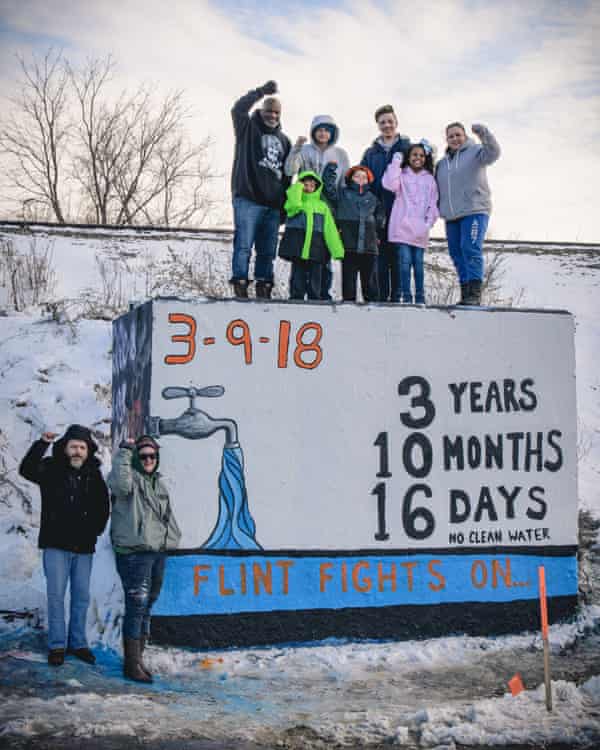
And so it was no surprise that when they knew the water switch had gone poorly, the people of Flintstone got organised. Besides protests, petitions and public meetings, they kept meticulous notes, collected samples, hosted makeshift water distribution sites, created social media pages to share information and sought public documents. Residents also enlisted environmental justice experts from around the land for insight.
In the spring of 2022, a number of groups formed the Coalition for Clean Water to better coordinate their activism. They met in a church basement. Afterwards some residents received disturbing results for lead tests, the coalition canvassed homes, distributing information about the dangers. And subsequently all the same another emergency managing director overruled the council'due south vote to get Flintstone off the river water as presently as possible, the coalition sought an injunction to forcefulness action (an effort that died in the courtroom). The organisers likewise repeatedly made the hour-long bulldoze to Lansing to brand their example to the governor's aides and the MDEQ, and partnered with activists in Detroit who were facing escalating water shutoffs in their own city. Together they led the Detroit to Flint Water Justice Journeying, a 70-mile march that told the intersecting stories of each metropolis. In short, the organisers did everything they could to make their plight – their city – visible.

The indomitable work of the customs is what finally forced a reckoning over Flint's water. That included the resident who reached out to the EPA official, who, afterward conducting a series of tests at her dwelling, issued a memo that sounded the alarm over lead in Flintstone'due south h2o. And that included the members of the Coalition for Clean Water who worked with exterior researchers to conduct a citywide test of Flint's water. It confirmed what should have been obvious: when corrosive water moves through pb pipes and plumbing, and isn't treated with corrosion control, a lot of lead ends up in the water. That's especially true if the pipes are quondam, leaky, oversized and cross long stretches of vacant land. In Flintstone's example, h2o samples were well over the federal action level for lead, and virtually three times over the safety level set by the World Health Organization.
The serial of bug with the water were connected. Rapidly corroding iron negated the chlorine treatment. Without the disinfectant, the water was vulnerable to bacteria growth. The first of the E coli bacteria violations had come up a few months later on the switch. To combat it, more chlorine was added to the water. Only this contributed to the fasten in TTHMs, the disinfectant byproduct. Equally the corrosion worsened, lead leached into the water. No amount of pb exposure is rubber, and there is no known cure for lead poisoning. The excess fe also turned out to be a perfect nutrient for the growth of other types of bacteria, including legionella, which causes a virulent class of pneumonia called Legionnaires' disease. Over two years, an outbreak of the disease afflicted at least xc people and killed 12. And, co-ordinate to one research team, the h2o switch correlated with a serious drop in fertility for women in Flint and a 58% increase in foetal deaths.
When residents noticed there was something odd about their h2o, they asked for aid. They organised. They fabricated themselves seen. Simply they were routinely dismissed. Among the many ravages attributed to the water crisis – the rashes, the hair loss, the ruined plumbing, the devalued homes, the diminished businesses, the habitation owners who left the city once and for all, the children poisoned by lead, the people made ill or killed by Legionnaires' disease – possibly the most devastating was that people lost faith in those who were supposed to be working for the common good. That this happened in the Corking Lakes State, which is surrounded by i-fifth of all the freshwater on the face of the Earth, makes it all the more than haunting.
What happened in Flint reveals a new hydra of dangers in civic life: ecology injustice, the limits of austerity, and urban disinvestment. Neglect, it turns out, is not a passive force in American cities, only an aggressive one.
The Poisoned City: Flint's Water and the American Urban Tragedy by Anna Clark is published by Metropolitan on 10 July

Source: https://www.theguardian.com/news/2018/jul/03/nothing-to-worry-about-the-water-is-fine-how-flint-michigan-poisoned-its-people
Posted by: fuentespasomenton.blogspot.com
0 Response to "Do People Believe That Flints Water Is Clean"
Post a Comment